

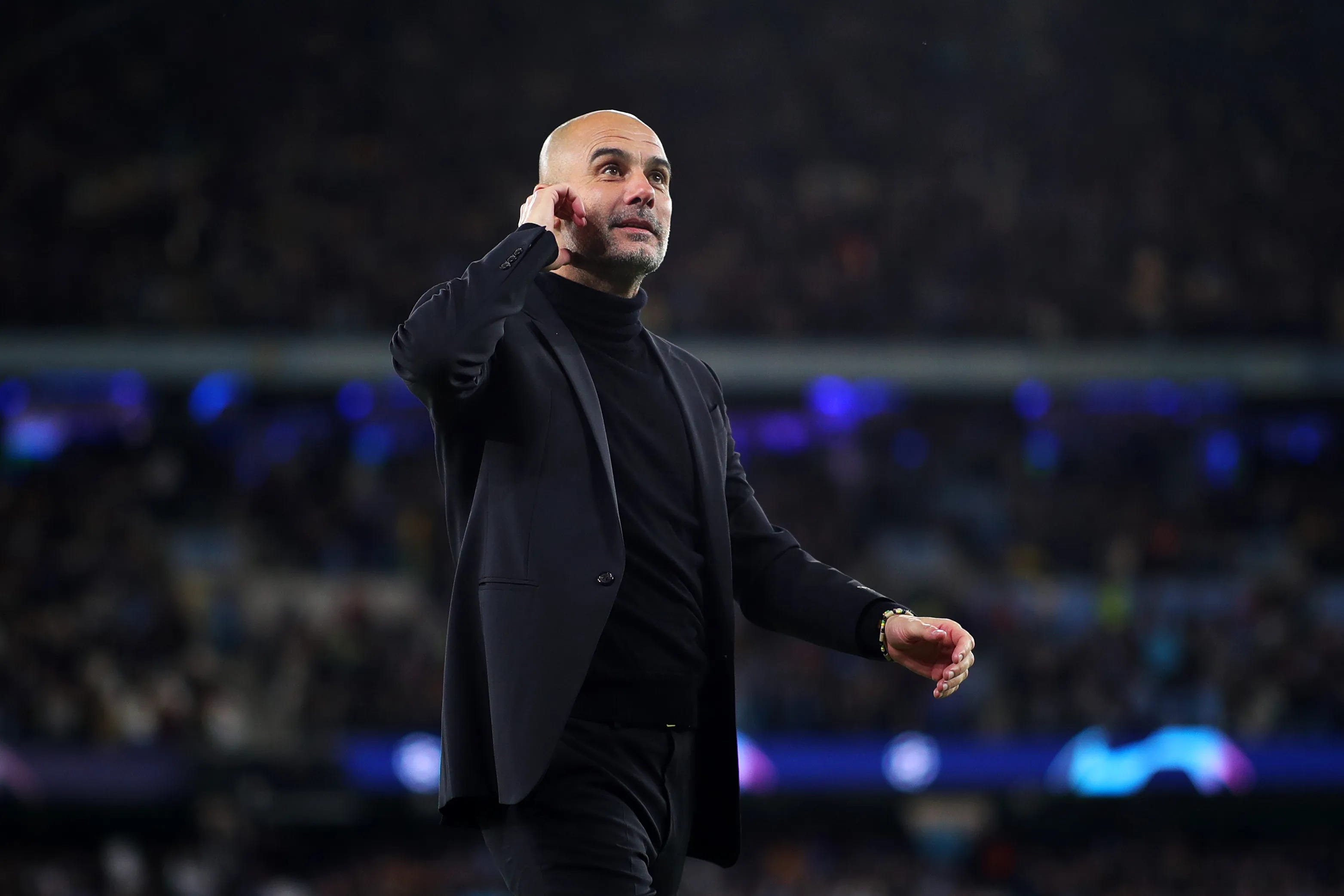
Josep (Pep) Guardiola Sala is one of football’s most influential and successful coaches, with 38 major trophies won in 17 years as manager of three different clubs. However, his possession style of play implemented at Manchester City has attracted scrutiny for removing the individuality of players, forcing them to conform to a role in a system that is becoming increasingly robotic. While his influence has influenced the likes of Arsenal to adopt similar principles, when the two sides met in March 2024, a 0-0 draw was the result, with Manchester City boasting 73% possession to Arsenal’s 27%: a robotic outcome. Key players like Gabriel Jesus, Foden, and Saka did not express their individual flair but conformed to a system.
So is Guardiola beneficial or detrimental to the way we watch the beautiful game?
To understand where Pep gained insight into his philosophy and how it later evolved into the supposed robotic nature at Manchester City, we must understand the work of his mentor and manager as a player at Barcelona (1989–1996), Johan Cruyff. During the 1990’s, Cruyff revolutionised the way Barcelona played through a positionless style of play known as ‘total football’, prioritising the ability of the players to adapt to roles in the defensive, midfield, and offensive areas of the game.
Total football involved controlling possession, pressing high to trap the opponent in their own half, and regaining possession. Total Football also utilised the goalkeeper as an extra player in the build-up by focusing on their ability to be comfortable on the ball and initiate attacks rather than just fulfilling their primary ability as a shot-stopper.
This style of play yielded great success for Cruyff and Barcelona in the 1990’s, through four successive league titles and the club’s first European Cup in 1992. This had a profound influence on Guardiola, who stated that Cruyff had ‘built the chapel’ and it was our (football’s) job to' maintain it’. From this, we can see the significant influence Cruyff’s work had on Guardiola in his early years.
During his reign as manager of Barcelona (2008–2012), he would build upon Cruyff’s ‘total football’ and refine it, birthing the infamous ‘tika taka’ style of football. Tiki Taka focused on short passing, retaining possession by finding the progressive pass and moving the ball into the opponent’s box slowly, unlike the infamous ‘route one’ style of kicking it long and hoping to win the ball, which was deemed a waste of possession. Guardiola would utilise the La Masia prodigies in Sergio Busquets, Xavi, Iniesta, and Lionel Messi, the centrepieces of his successes at Barcelona. Tiki Taka allowed Pep to create a numbers advantage in the midfield, which would allow Xavi, Iniesta, or Busquets to find a free man and play them through on goal via a progressive (direct) pass.
However, creating a numerical advantage would later form a centrepiece in Guardiola’s philosophy, which would later arguably translate into an obsession at Manchester City. However, he still retained and utilised critical elements of Cruyff’s ‘Total football’, by prioritising possession, his team would press their opponents higher up the pitch out of possession to create scoring opportunities. This created a high line, which necessitated defenders who were quicker than the ‘no-nonsense’ centre halves of old, contributing to monumental success, including a European treble in the 2008/09 season. Pep’s successes at Barcelona were not limited to the treble, with an estimated 2.36 points per game (PPG) in 247 games as manager. Pep’s use of La Masia products in Lionel Messi, Xavi, Busquets, and Gerrad Pique facilitated the later successes of these players, who would go on to become club legends after his departure in the 2011/12 season. Guardiola also broke records while at Barcelona, becoming the first team to win six trophies in a calendar year (2009), as well as winning 14 of 19 possible trophies while in charge.
Guardiola’s successes raised many eyebrows in the footballing world whilst at Barcelona, most notably toppling one of football’s greatest managers on the biggest stage in Sir Alex Ferguson twice, in the Champions League Finals in 2008/09 and 2010/11. Pep’s Tiki Taka football and his use of a 4-3-3 formation arguably retired the use of a 4-4-2 formation for more ambitious clubs, as the three midfielders in the 4-3-3 were able to play more progressive passes to the front three, unlike the two midfielders in the 4-4-2, whose aim was to absorb pressure rather than create it. The 4-4-3 became another centrepiece of Guardiola’s footballing philosophy, taking it with him to Bayern Munich and Manchester City.
Pep’s 3-year stint in Munich (2013–2016) was somewhat of a continuation of his success at Barcelona, with three successive Bundesliga titles and a domestic double in the 2015–16 season. However, he was unable to replicate his European glory as he did with the Blaugranas, failing at the semi-final stage in all three seasons at the hands of Real Madrid (2013–14), Barcelona (2014–15), and Atlético Madrid (2015–16), unable to escape the Spanish dominance that was engulfing Europe at the time.
So from his earlier successes in his career, we can comfortably say Guardiola was undoubtedly revolutionary in the football world, with pure tactical genius overriding the status quo within an instant. However, does his time at Manchester City suggest that you truly do grow ‘more conservative with age?’.
Guardiola inherited the Manchester City job in 2016, and with it came a decrepit squad. The Cityzens had just finished in fourth, 15 points adrift of champions Leicester City. Guardiola needed to implement rapid change in the transfer market with an almost infinite transfer budget. Guardiola acted immediately, bringing in centre-half John Stones from Everton, prominent winger Leroy Sané, midfielder İlkay Gündoğan, and most notably, goalkeeper Claudio Bravo, unseating the established and Premier League-proven Joe Hart.
This was ‘Vintage’ Guardiola: nobody was safe and guaranteed a place in the starting eleven. From his initial transfer window and preseason, we can begin to see the principles of perfectionism, professionalism, and leadership he began to instill within the dressing room.
However, Rome was not built within a day, and neither was Guardiola’s conquest of English football, which would result in a third-place finish in his first season, with a better points total than before (78 compared to 66), but still 15 points adrift of first place.
However, as expected, on the field, a transformation had already occurred, most notably through adopting his infamous 4-4-3 and switching to a 3-2-5 while in possession. Guardiola had also transformed the role of the full-back into a more attacking threat, a first within the league. This would involve dropping his defensive midfielder Fernandinho into defensive while playing out from the back. This small tweak proved to be revolutionary with how full-backs were perceived in both build-up and transitioning to attack. Guardiola had only been in England for one year and was already proving to rip up the status quo.
In the subsequent transfer window in 2017, Guardiola continued to implement his philosophy and was not afraid to spend the cash either, with a total spend of £213.8 million in the summer. This would involve the signings of Bernardo Silva, Ederson, and Kyle Walker.
The following season (2017/18), Guardiola’s men would break multiple records, winning the league by 100 points, becoming the ‘centurions’. The summer signings had also excellently translated to their success tactically too, with Ederson’s ability to distribute the ball making City extremely press-resistant, allowing them to dominate possession. Guardiola's ball was in full flow at this point, with his team averaging 71.9% possession. Once again, we can see elements of Cruyff’s Total Football seeping in here, translating to success.
Guardiola would retain the title once more in 2019, despite a lengthy challenge by Liverpool, taking them all the way to the final day of the season, where Manchester City retained their title by a single point, or in John Stones’ case, 11 millimetres.
So by 2019, Guardiola’s Manchester City were high flyers domestically, with back-to-back league titles, but European success seemed a distant dream, failing to reach the semi-final stage in both seasons. So from his initial success, it seemed business as usual for Pep: continuing to instill his tactical influence on the English game. So how did Guardiola’s initial revolutionary impact translate to almost robotics by the 2023–24 season?
It all started with the introduction of the first signs of a box midfield during the 2019–20 season. This would lead to his team switching from a 3-2-5 to a 4-2-2-2 in possession. Summer signing Rodri replaced now-veteran Fernandinho in defensive midfield. Going forward, the team no longer played through Sergio Aguero, with Gabriel Jesus sometimes starting ahead of him or Sterling playing as a second centre-forward. Gundogan was also tasked with dropping back into a double pivot to aid Rodri in midfield, with one of the wide players, Bernardo Silva or academy graduate Phil Foden, coming infield and completing a square box-shaped midfield, which would be completed by De Bruyne.
This meant he had become less reliant on individual brilliance from Aguero, Sterling, or De Bruyne, whose injuries had become a problem that Guardiola had to solve through tactical changes rather than personnel changes.
From this, Guardiola began to micro-manage his players from roles in defence to their roles going forward, almost viewing them like pawns on a chess board. This had led to Guardiola often overthinking the tactical approach to games, notably the 2020/21 Champions League final against Chelsea. This involved dropping defensive midfielder Rodri from the lineup, whose presence was sorely missed when a lack of defensive cover allowed Kai Havertz to be played through on goal and score, leading to his side suffering a loss in the club’s first Champions League Final—a night to forget for Pep.
On the field, however, we can begin to see his philosophy take another form once more, through using a ‘false nine’, moving to a 2-3-3-2 in possession, with his wide players acting as split strikers accompanied by three attacking midfielders behind. While this was Guardiola’s third Premier League title out of a potential five, what was more surprising was his adopting a more cautious style of play, pressing less aggressively, and becoming more patient.
Guardiola had abandoned one of the key principles of Total Football, with his style of play becoming significantly less entertaining to watch. We can argue that this was a decisive turning point within his reign, choosing to prioritise winning over entertaining football. This had an immediate effect, with the average opposition passes per defensive action (PPDA) increasing from 8.3 in 2016/2017 to 11.5 in 2020/21 because of their reduced pressing.
While the departure of Aguero at the end of 2020/21 was a big hit to Guardiola, who claimed ‘we cannot replace him’, Guardiola retained the Premier League title once again in 2021/22, by a single point. He still bore no success in Europe, despite a spirited Real Madrid comeback in the semi-finals.
His solution? Star striker Erling Haaland is the final piece in his conquest for dominance in English football.
Haaland slotted in immediately, with back-to-back hattricks in his fourth and fifth games. Guardiola had found his solution to the hole left by Aguero, and Haaland did not disappoint, netting 52 times in 54 games as Manchester City completed a historic treble, lifting their first Champions League trophy.
Guardiola had done it; he had given Manchester City their elusive European glory, but at the cost of sacrificing key footballing principles that had given him such prominence in the first place. Guardiola strolled to a fourth successive league title in the 2023–24 season, almost making the ‘greatest league in the world’ look like a walk in the park.
At present, it seems the only way to beat Guardiola is to adopt the same principles and hope you can achieve similar success. Vincent Kompany tried this at Burnley in the championship (2022/23), raising many eyebrows as Burnley were infamous under Sean Dyche for ‘Brexit ball’, kicking it long to the tall striker when possible. As expected, this generated success, as Burnley achieved promotion to the Premier League. Similarly, albeit questionable, former assistant manager Mikel Arteta has implemented a similar system at Arsenal, allowing them to challenge Manchester City for the Premier League title in the last two seasons, falling just short because of a combination of fixture congestion and the sheer running his system requires. This is exemplified by defensive midfielder Declan Rice having covered an immense 413 km over the course of the campaign. From this, we can deduce that copying Pep is easier said than done, and to successfully best him requires a lot more than just tactical prowess, as Jose Mourinho found out on many occasions.
Guardiola’s influence, however, has also changed individual roles that define a player, limiting their individual talent and focusing on their contribution to the system instead. This has made football less individualistic, notably marked by the number 10 position ‘dying out’, with players expected to conform to their role in the system rather than roam freely, which is where they perform the best. This is best exemplified through James Rodriguez, a classic example of a number 10, who, in today’s game, is not desired but instead only able to find playing time in Brazil at São Paulo, as retaining possession is considered more desirable than taking a risk, which could result in a moment of brilliance or a moment of wasted possession. This idea of a'system player’ was also seen with Phil Foden’s lacklustre performance at Euro 2024, failing to register a goal or an assist in all seven of England’s games. While this may be down to Gareth Southgate’s cautious play, the Premier League’s player of the year is capable of delivering when it matters, but only under a system suited to him, it seems.
From this, we can reach the conclusion that, in the short term, Guardiola is a revolutionary, transforming the style of play in whatever situation he inherits, allowing them to dominate and achieve success. However, his time at Manchester City suggests that in the long term, his desire to achieve efficient outcomes severely dilutes the individual talent of his players, limiting their overall output, and if they can’t perform, they are sold.
So is Pep Guardiola delivering the next great players of our generation, or is he like the infamous Nike ad, making them akin to robots? The future will only tell, but with six bald managers with somewhat similar playstyles in the Premier League next season, football will never be the same.